Align the Fibers : Indigo
Update:
November 2025
The season is coming to a close, It has been a busy year of change and also MORE learning! We learned about what the fields do when they have been planted in with no inputs for multiple years, broadcasting vs. starts, nitrogen scavengers, we have had the highest yield yet of indigo per processing. So, next year will be even more productive!! Thank you to everyone that has supported us this year, buying a tote at Magnolia Gardens and Plantation, as Arianne King Comer invited Precious to make some art and the giftshop generously stocked some bags she designed while there with Hank Herring’s stamps he custom-made! Our capacity for processing increased with a donation of equipment from ChiDesign Indigo, it was a small processing year, as we assess how to move forward with how to grow and harvest for the highest yield, cost of labor, plants, and time and honor community, heritage and history everystep of the way.
questions about indigo? processing? want to support? please email: alignthefibers@gmail.com
December, 2024
We have ended our second year harvesting! We were set up at Roots and Shoots Nursery, and had so many volunteers come and help cut, donate their time and efforts to make this season possible! Alot was learned, networking and educating with International Center for Indigo Culture. Researching scaling production even more, working on a “fun”raiser, and of course the many uses of Indigo. Precious just successfully made some Indigo tofu with a local chef. A fiber piece is on exhibit at City Gallery invited by Caroline Gutman who has been documenting indigo for 4years the exhibit named “Children of Indigo”. If you are interested in knowing more
contact: alignthefibers@gmail.com
Project Indigo:
We are currently focused on the textile dye Indigo, which is the “original blue jean dye”. There are 50 different species of this plant that are historically and currently grown around the world. We are currently focused on the textile dye Indigo, which is the “original blue jean dye”. Shifting to American-grown indigo products, the industrial market can slowly be transitioned to more safe and sustainable production, while supporting a new generation of farmers and processors in the Low Country.
November 2025
The season is coming to a close, It has been a busy year of change and also MORE learning! We learned about what the fields do when they have been planted in with no inputs for multiple years, broadcasting vs. starts, nitrogen scavengers, we have had the highest yield yet of indigo per processing. So, next year will be even more productive!! Thank you to everyone that has supported us this year, buying a tote at Magnolia Gardens and Plantation, as Arianne King Comer invited Precious to make some art and the giftshop generously stocked some bags she designed while there with Hank Herring’s stamps he custom-made! Our capacity for processing increased with a donation of equipment from ChiDesign Indigo, it was a small processing year, as we assess how to move forward with how to grow and harvest for the highest yield, cost of labor, plants, and time and honor community, heritage and history everystep of the way.
questions about indigo? processing? want to support? please email: alignthefibers@gmail.com
December, 2024
We have ended our second year harvesting! We were set up at Roots and Shoots Nursery, and had so many volunteers come and help cut, donate their time and efforts to make this season possible! Alot was learned, networking and educating with International Center for Indigo Culture. Researching scaling production even more, working on a “fun”raiser, and of course the many uses of Indigo. Precious just successfully made some Indigo tofu with a local chef. A fiber piece is on exhibit at City Gallery invited by Caroline Gutman who has been documenting indigo for 4years the exhibit named “Children of Indigo”. If you are interested in knowing more
contact: alignthefibers@gmail.com
Project Indigo:
We are currently focused on the textile dye Indigo, which is the “original blue jean dye”. There are 50 different species of this plant that are historically and currently grown around the world. We are currently focused on the textile dye Indigo, which is the “original blue jean dye”. Shifting to American-grown indigo products, the industrial market can slowly be transitioned to more safe and sustainable production, while supporting a new generation of farmers and processors in the Low Country.
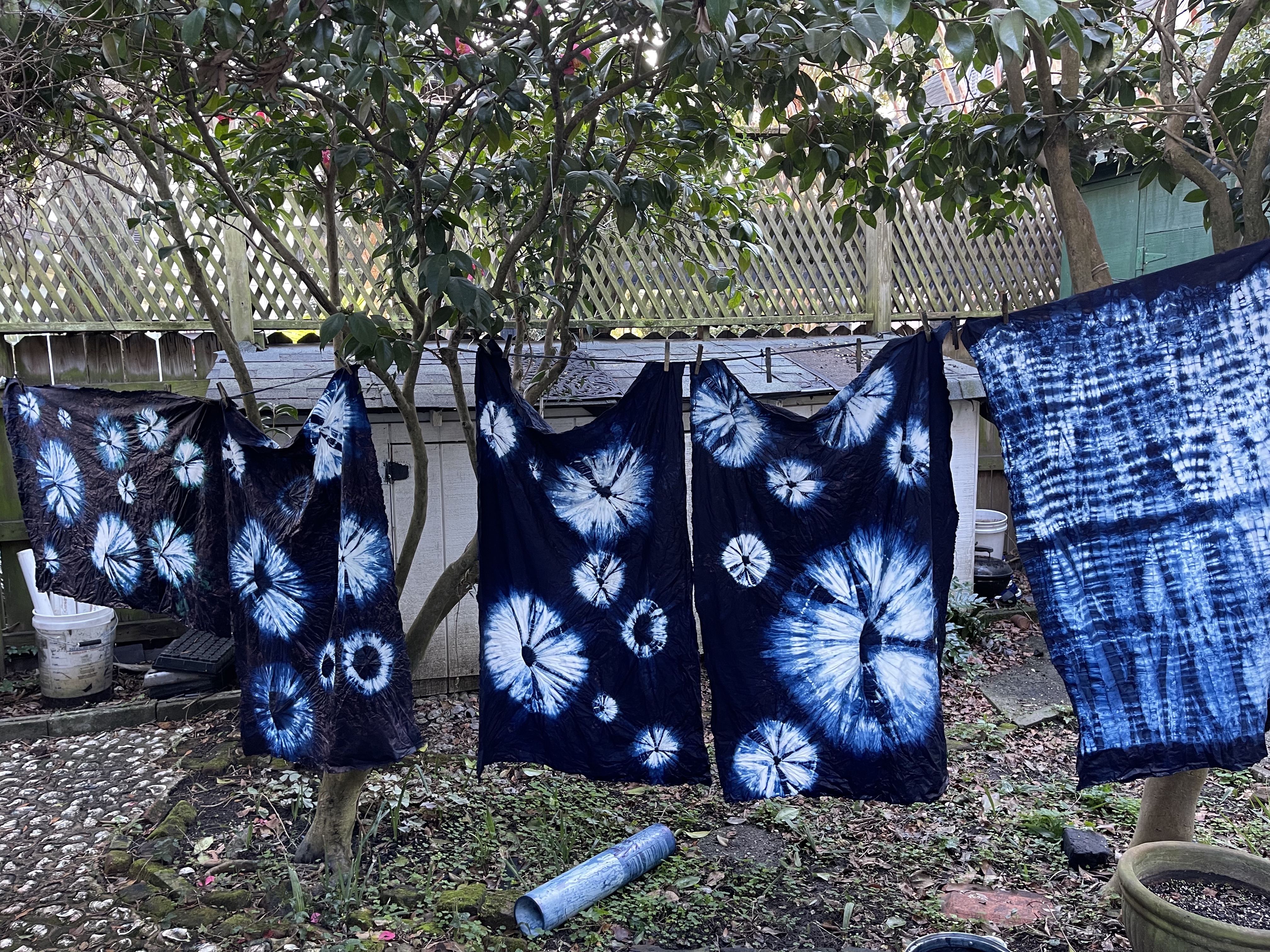
Indigo plants are harvested, water fermented, filtered, and then dried into powder using a natural and non-chemical process, which can then be used to make a liquid dye. Closed-loop, zero-waste processing of indigo adds value to this nitrogen-rich plant by using the bio-waste created to make fertilizer or compost onsite with True Earth’s guidance.

Why Mobile? Mobile processing directly services the communities. This mobility also provides pick-up service to multiple farms growing in the community and a central mobile source of education.
Fun Fact: insects of indigo! The indigo provides a home for so many insects, frogs, butterflies, bees, different types of caterpillars, and praying mantes.